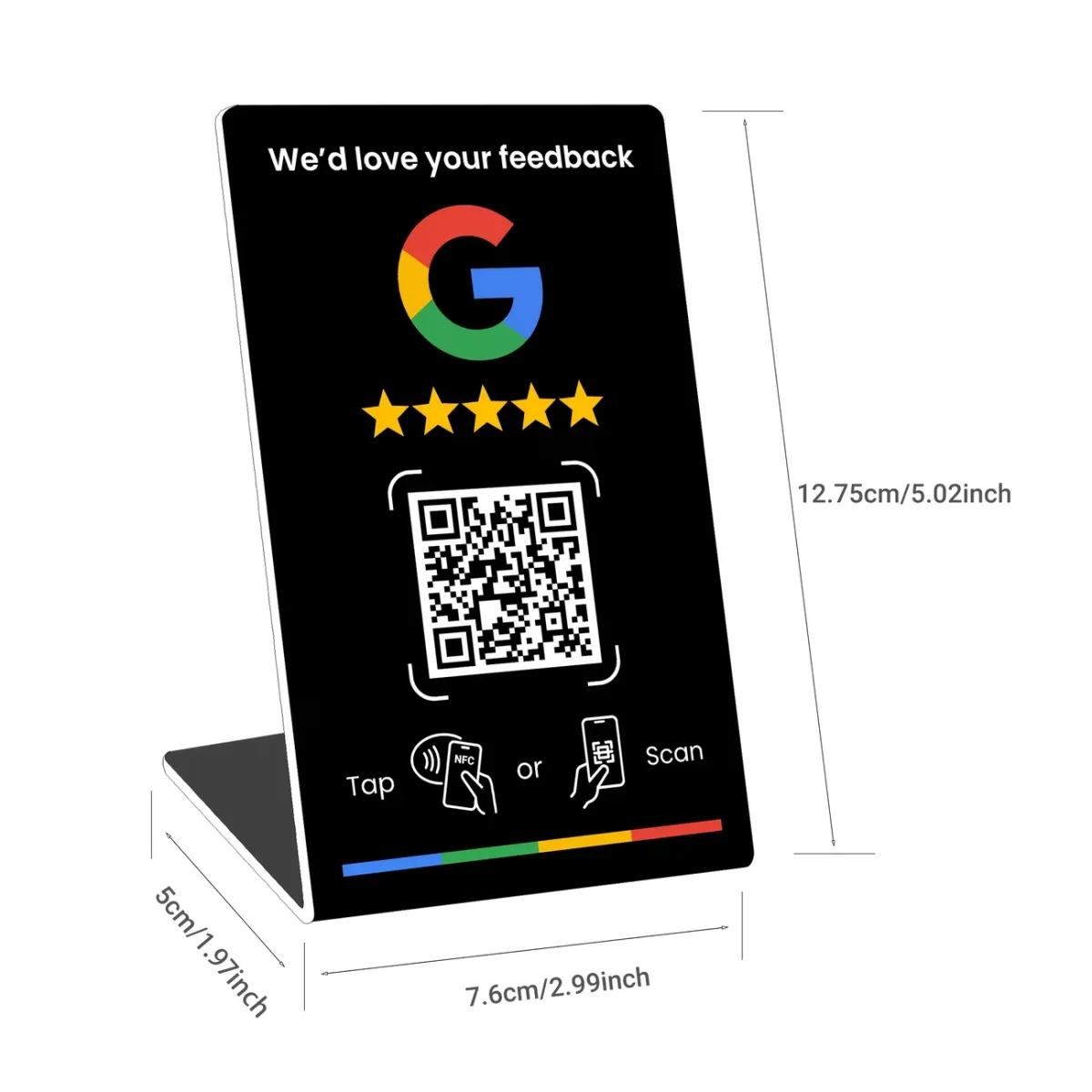
Almost every local business has the same problem: happy customers every day and a Google profile that looks frozen in time. It is not a quality problem, it is the lack of a short path between "I liked it" and "I reviewed it". This article explains how to shorten that path with an NFC plate on the counter, what to say to the customer and what Google does and does not allow.
Why reviews stall
Think about what happens when you ask for a review the usual way: "If you can, leave us a review on Google." The customer says yes, leaves, gets in the car, gets home, and the intention is gone. When they remember, they would have to open Google, search for your business, find the right button and write. Five steps for something that gives them nothing in return.
Reviews show up when those five steps become one. And the only moment the customer is willing to take that one step is while they are still in front of you, with the experience fresh and the phone in their hand.
The right moment is now, not "at home"
The rule is simple: ask at the peak of satisfaction. In the café, when the customer praises the cake. In the clinic, at the end of the appointment. In the salon, when they look in the mirror. In the restaurant, when they ask for the bill and say everything was good. In that instant the wish to give something back is real; ten minutes later it is not.
What is missing in that moment is a path that does not require searching for anything. That is where the plate comes in.
How an NFC + QR plate works
A review plate carries two technologies in the same object:
- NFC: a small chip inside the plate. The customer taps it with their phone and a notification opens with the link. It works on recent iPhones and Androids, with nothing to install.
- QR code: printed on the plate, for those who prefer to point the camera or have a phone without NFC.
Both lead to the same place: the review window of your Google profile, already open on the right business. The customer only has to pick the stars and write two lines. On the Bilouro NFC plates the link is set up by us, so the plate arrives ready: put it on the counter and it works.
Where to put the plate
Placement decides everything. A plate hidden next to the coffee machine is useless. Three spots that work:
- Next to the payment terminal. The customer is already standing still, phone in hand, waiting for the receipt. It is the best spot in most shops, cafés and clinics.
- On the table, in restaurants and terraces: one card per table, ideally the same card that opens the digital menu.
- At reception or the exit counter, in salons, gyms and practices, where there is always a goodbye moment.
If you have a shop window or a till with no room, the 3M sticker card version sticks to any flat surface.
What to say (one sentence is enough)
The plate does the technical work; the team makes the invitation. No speech needed, just one natural sentence at the right moment:
"If you enjoyed it, tap your phone here and leave us a review. It takes thirty seconds and helps us a lot."
Three things make this sentence work: it is said at the moment of satisfaction, it points to a concrete gesture ("tap here") and it says how long it takes. Train the team to say it whenever they hear a compliment. Over time it stops being a request and becomes part of the service.
What Google allows and what it does not
Asking for reviews is allowed and even encouraged by Google. What Google's content policies forbid is something else:
- Offering something in return for a review (a discount, a gift, a prize draw).
- Filtering who reviews, asking only happy customers or steering unhappy ones to a private form before letting them reach Google.
- Writing reviews on behalf of customers or buying them.
The plate is neutral: any customer can use it and lands on the same page. That is exactly what Google wants. Keep the request the same for everyone and you will have no problems.
And when a bad review arrives?
It will happen, and it is not the end of the world. A profile with nothing but five stars looks fake; a profile with many reviews, mostly good, and polite replies to the bad ones conveys trust. Always reply, within 24 to 48 hours, calmly and without arguing: thank them, acknowledge the problem if there was one, explain what you will do. People who read reviews notice your reply more than the complaint.
The same trick works for Instagram
If your business lives on image, there is a second request that costs the customer even less: following you on Instagram. The logic is the same. Nobody will type your name into the search bar when they get home, but they will tap a "Follow us on Instagram" plate while waiting for their change. Salons, studios, bakeries and clothing shops are the obvious cases.
In short
- Ask at the moment of satisfaction, not "at home".
- Give a one-step path: an NFC + QR plate where the customer is already standing still.
- One sentence, always the same, said by the whole team.
- Never offer anything in return and never filter who reviews.
- Reply to every review, especially the bad ones.
The plates and cards, with prices, sizes and a demo menu for restaurants, are at nfc.bilouro.com. If you would rather talk before ordering, write to nfc@bilouro.com.