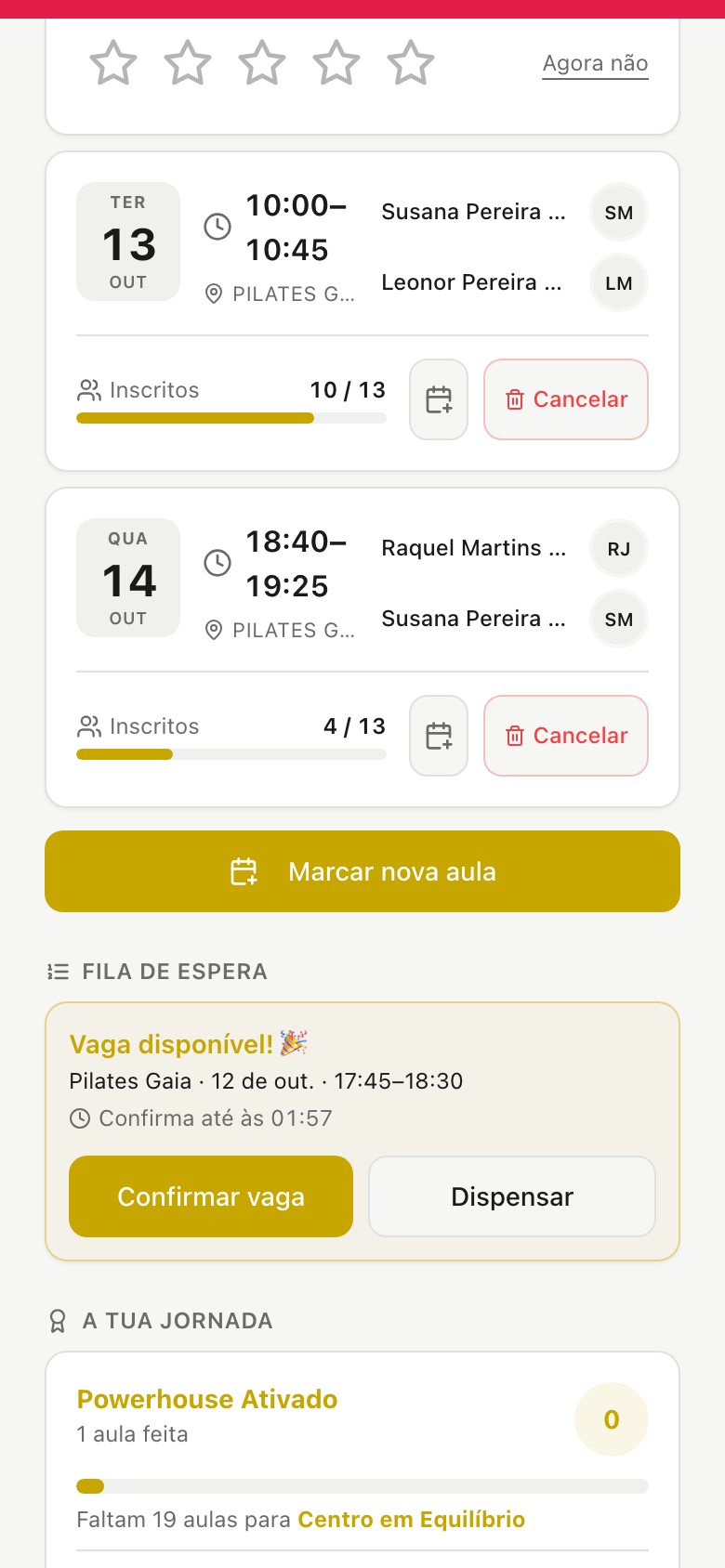
In a gym or studio with group classes there are always two queues at once: people who want to get into a full class, and seats that open up when someone drops out. The trick is matching them in time. A drop-out at 5:30 p.m. for the 6 p.m. class is rarely filled by hand — and an empty seat in a class with a queue is lost revenue and lost goodwill.
A well-designed waitlist solves this without anyone on the team stepping in.
Why manual waitlists fail
Many studios already have a "waitlist": a name on paper, a note on a phone, a saved message. It almost always fails for the same reasons:
- It's too late. By the time someone on the team sees the cancellation, there is no time left to tell anyone.
- It depends on who is on duty. In the evening, at weekends or during a class, nobody is watching messages.
- It isn't fair. Whoever answers first gets the seat, even if someone else was ahead.
- It creates too many conversations. To fill one seat you message three people, two reply late and one is annoyed.
How an automatic waitlist works
The principle is simple: when a class is full, the person joins the queue with one tap. When someone cancels, the system offers the seat to the first in line, with a deadline to confirm. If they don't confirm, it moves to the next.
The details make the difference:
- The confirmation deadline adapts to the class time. A seat in a class two days away can wait a few hours; in a class an hour away, it has to be fast. Deadlines of 2 hours, 1 hour or 30 minutes, depending on how close the class is, work well.
- The clock stops overnight. Nobody should lose a seat because the offer arrived at 3 a.m. Pausing the deadline overnight fixes this.
- In the last hour, the seat is open to everyone. Close to class there is no time to wait for answers in sequence. Opening the seat to whoever grabs it first keeps it from staying empty.
- People see their position in the queue. Knowing you are second helps you decide whether to wait or pick another class.
- The team sees every queue live. And can confirm a seat on behalf of a member who phoned the studio.
Rules worth deciding up front
- How late can members cancel without losing the class? A common rule is free cancellation up to 1 hour before; after that the class counts as taken, but the seat is released to the queue.
- How many queues at once? A limit stops anyone "reserving" every class of the week just in case.
- Do people in the queue have credits? If the seat is confirmed, the class must be deducted from the plan like a normal booking.
The numbers that show it's working
Measure three things:
- Fill rate: of the seats offered, how many were confirmed.
- Lost seats: classes that started with empty places even though there was a queue.
- Time to confirmation: how long, on average, it takes for a seat to be filled.
At Breath Pilates, where Studio App's automatic waitlist runs every day, around 90% of offered seats get filled.
In short
Last-minute cancellations are inevitable; empty seats with a queue at the door are not. An automatic waitlist — with deadlines that adapt to the class time, an overnight pause and opening to everyone in the last hour — fills those seats without anyone on the team picking up the phone.